Nakalulungkot lamang isipin na hindi na kita makakapanayam tungkol sa isa sa mga mahahalagang pelikula ni Mega, ang Dear Heart...
Showing posts with label Student Life. Show all posts
Showing posts with label Student Life. Show all posts
Wednesday, March 13, 2013
Kilig-kilig to the Bones: Queer-ing Danny Zialcita
Isang queer na pagsusuri sa ilang mga pelikula ng itinuturing kong isa sa mga underrated directors ng pelikulang Filipino na si Danny Zialcita! Hindi malilimutan ng industriya ang mga obrang ginawa mo. Hindi magtatagal ay maihahanay ang galing mo sa mga naunang lumisang auteurs sa iyo. Hinahangaan kita! Ipinagbubunyi kita!
Nakalulungkot lamang isipin na hindi na kita makakapanayam tungkol sa isa sa mga mahahalagang pelikula ni Mega, ang Dear Heart...
Queer-ing Danny Zialcita from Jek Josue David on Vimeo.
Nakalulungkot lamang isipin na hindi na kita makakapanayam tungkol sa isa sa mga mahahalagang pelikula ni Mega, ang Dear Heart...


Tuesday, November 06, 2012
Ang Entablado sa Pelikulang "Tunay na Ina" (1939) ni Octavio Silos

Ang Tunay na Ina (1939) ay kuwento ni Magdalena (Rosario Moreno) na biktima ng panghahalay ni Antonio (Exequiel Segovia), isang lalaking may pagtingin sa kanya subalit hindi niya gusto. Ito ay nauwi sa kanyang pagbubuntis na hindi sinang-ayunan ng kanyang ama (Precioso Palma). Dahil sa kahihiyang idudulot ng sanggol sa kanilang pamilya at sa kanyang magiging kinabukasan pa, nagpasya ang ama ni Magdalena na ipaampon ang apo. Sa tulong ng kanilang kasambahay, ibinigay ang sanggol kay Aling Andang (Naty Bernardo).


Ang pelikulang Tunay na Ina, katulad ng mga pelikulang nauna rito, ay nag-ugat sa mga kuwentong pang-teatro, partikular ay ang sarsuwela. Ang sarsuwela ay kadalasang kuwento ng pag-iibigan ng mga bida na minsa’y katawa-tawa at dinaraan sa iba’t ibang awitin o sayaw. Ang mga pangunahing bida ay napapabilang sa mga mayayaman at mahihirap. Ang naturang antas sa buhay ang minsang nagiging balakid sa mga bida na kinakailangan nilang mapagtagumpayan.
Ang Tunay na Ina ay gumagamit ng musika upang ipahatid ang nararamdam ng kanyang mga pangunahing tauhan. Ang awiting “Buhat” mula sa komposisyon ni Miguel Velarde, Jr. at titik ni Dominador Santiago ay makailang ulit na aawitin nina Magdalena at Roberto sa iba’t ibang okasyon ng kanilang buhay. Sa ganitong pagkakataon ay nagbabago rin ang kahulugan ng nasabing awitin. Ito ay awitin ng pagsinta sa dalawang taong maituturing na umibig sa unang pagkikita pa lamang; ito ay awitin ng mag-irog na ipapaabot hanggang sa dambana ang kanilang pagmamahalan; ito ay awitin ng isang ina na nagmamahal at nangugulila sa kanyang anak, at; ito ay awitin ng mag-asawang lubos ang kaligayahang nararamdaman sa pagkabuo ng kanilang pamilya.


Ang ganitong istilo ng pag-awit at paglalapat ng musika ay hindi naman tuluyang tinalikdan ng pelikulang Filipino. Mula sa entablado noong panahon ng Kastila hanggang sa musical ng Hollywood, nagpatuloy ang istilong ito. Noong dekada otsenta ay makailang ulit ding narinig ang ilang popular na awitin sa pelikulang Bituing Walang Ningning (Emmanuel Borlaza, 1985) sa iba-ibang pagkakataon sa buhay ng kanyang mga karakter na sumasalamin sa kanilang pinagdaraanan (David 2010). Ngayong dekadang ito, hindi man lubusang inaawit ng mga bida ang theme song ng pelikula ay maririnig naman ito sa mga piling eksena sa kanilang buhay, instrumental man o may halong boses ng mang-aawit. Sa Unofficially Yours (Cathy Garcia-Molina, 2012) ay tuluyan nang umawit ang mga bida upang ipahatid ang kanilang pagmamahal sa isa’t-isa gayong hindi musical ang pelikula.
Ang Tunay na Ina ay tumatawid na sa isa pang uri ng dulang pang-teatro, ang drama. Madrama ang kuwento ng buhay ni Magdalena at hindi naging madali para sa kanya ang lagpasan ang trahedya ng kanyang buhay. Siya na ang naging biktima ng panggagahasa, siya pa rin ang umani ng hirap na dulot nito: ihiniwalay sa kanya ang anak, ikinahiya ng kanyang ama ang nangyari sa kanya, nilayuan siya ng kanyang asawa nang malamang nagkaroon siya ng anak sa pagkadalaga, at namatayan siya ng isa pang anak sa mga sandaling iginugugol niya ang kanyang panahon sa anak na nawalay sa kanya. Samantalang ang lalaking umabuso sa kanya ay nanatiling malaya at nakuha pang takutin siya at maging kaibigan ng kanyang asawa.

Kakikitaan din ang pelikula ng double standard na ipinapataw sa mga lalaki at babae. Ang babae ay hindi na maituturing na karapat-dapat para sa isang lalaki kung siya ay nabahiran na ng “dungis” ng iba (kahit pa ang lalaki ang nagdulot nito sa kanya). Nakakahiya na siya sa tingin ng iba at maging ng kanyang pamilya. Malaki ang simbolismong pinahahayag ng kanyang pangalang “Magdalena,” ang babae sa Bibliya na itinuturing na makasalanan at sinasabi ng ilan na isang babaeng puta. Subalit katulad ni Hesus, siya ay pinatawad Nito kapalit ng kanyang pagsisisi at pagbabalik-loob. Si Magdalena sa Tunay na Ina ay pinatawad ng kanyang pamilya matapos niyang maranasan ang hirap sa pagsasabi ng katotohanan sa asawa at sa pagkamatay ni Junior.

Ang Tunay na Ina ay isang pelikulang maituturing natin na bunga ng kanyang panahon. Nasa pananakop ng mga Amerikano noong taong 1939, may banggaang nagaganap sa mga ugaling pinahahayag ng pelikula mula sa mga nakagawiang tradisyonal na Kastila at makabagong Amerikano.
Si Magdalena ay larawan ng isang makabagong babae na tanggap ang kanyang anak kahit pa ito ay dulot ng isang pagkakamali. Subalit bilang isang babae ay hindi siya makakapalag sa patriarkang sistema. Ang kanyang ama pa rin ang nasunod sa desisyong ilayo sa kanya ang kanyang anak. Siya rin ang naging talunan nang malaman ng kanyang asawa ang kanyang pagiging dalagang-ina. Ninanais lamang niyang itama ang kanyang pagkakamali sa kanyang unang anak subalit pinagbayaran niya ito nang matindi. Sa huli ay nauwi rin ang kanyang kapalaran sa pagpapatawad at pagtanggap sa kanya (at kay Tita) ng kanyang asawa upang mabuo ang kanyang pagkatao. (May pagkakataon sa pelikula na gusto na niyang wakasan ang kanyang buhay dahil pakiramdam niya’y wala na itong halaga. Hindi siya matanggap ni Tita bilang ina at hindi rin siya tanggap ni Roberto bilang asawa.)

Representasyon ng makabagong lipunan ang makabagong kasuotan ng mga pangunahing karakter na napapabilang din sa angkan ng mayayaman. Sa kabilang banda, ang mga may tradisyunal na pag-uugali, mahihirap, at nakatira sa nayon ay nakasuot ng Filipinong kasuotan.
Ang teatrong pinagmulan ng pelikula ay hindi rin maikakaila sa istilong ginamit nito sa paglalapat sa pinilakang-tabing. Melodramatic subalit kalkulado ang galaw ng kanyang mga artista. Kadalasan ay nalilimitahan sila sa apat na sulok ng kuwadrado katulad ng entablado at nananatili sa gitna nito. Hinahayaan na lamang nila ang kamera na siyang lumapit sa kanila para sa kanilang close-up. Ang mga kuha ng kamera ay mabibilang din lamang sa tatlo: wide shot, medium shot, at close-up. Subalit ginagamit na rin nito ang editing techniques na nagmula pa sa Hollywood kahit pa hindi pulido ang pagkakagamit nito. May mga pagkakataong makikitang nakahinto ang isang artista at naghihintay na bigyan ng hudyat ang kanyang paggalaw. Katulad din ng mga teleserye sa panahong ito sa ating telebisyon, humihinto ang kanilang galaw bilang transisyon para sa susunod na eksena o kaya’y upang mabigyang-diin ang ekspresyon sa kanilang mga mukha.

Gumamit din ng irony ang pelikula na madalas ay nagiging sangkap ng kuwento. Kabilang dito ang pag-awit ni Tita sa isang pagtitipon, “Maligayang Pasko, araw ng kasayahan...” Subalit kaiba sa mga naunang dalawang sandali nang pag-awit niya nito, nagdurugo ang kanyang puso. Hindi niya madama ang tunay na kaluguhan ng awitin. Lumuluha siya sapagka’t nalaman niyang malubha ang sakit ni Aling Andang. Mas nais pa niyang makapiling ang ina kaysa makipagsayahan.
Isa ring teknik na ginamit ng pelikula na magpahanggang-ngayon ay ginagamit pa sa paggawa ng pelikula ay ang loveteam. Ang Tunay na Ina ay ang ikatlong pelikula na pinagsamahan nina Rosario at Rudy na bunsod ng matagumpay nilang tambalan noong unang pagkakataon (Video 48 2010).
Bilang produkto ng kanyang panahon, ang Tunay na Ina ay hindi nararapat na panoorin gamit ang modernong mata at makabagong pag-iisip. Bagkus ay dapat itong tingnan nang may halong pagkamangha sa kung paano ba nabuo ang pelikula noong dekadang ito. Bukod pa rito, ang kasaysayang napapaloob dito ang maaaring magpaliwanag sa mga kasaysayang napapaloob sa kuwento ng makabagong panahon at maaaring magsabi kung nagkaroon ba ng pagbabago o nananatili pa rin tayo sa panahong inakala nating iniwanan na natin.
(Mapapanood ang Tunay na Ina sa You Tube page ni Gobitz. Unang bahagi ng anim na paghahati ay matatagpuan dito: Tunay (1938) 1/6. Para sa mga umiibig sa pelikulang Filipino, ito ay karapat-dapat na mapanood.)
References
Book Tiongson, Nicanor G. “From Stage to Screen: Philippine Dramatic Traditions and the Filipino Film.” Readings in Philippine Cinema. Ed. Rafael Ma. Guerrero. Quezon City, Philippines: Rapid Lithographic & Publishing House, 1983. 83-94.
Film
Bituing Walang Ningning. Dir. Emmanuel Borlaza. Perf. Sharon Cuneta, Cherie Gil, and Christopher de Leon. Viva Films, 1985. Film.
Unofficially Yours. Dir. Cathy Garcia-Molina. Perf. John Lloyd Zruz and Angel Locsin. Star Cinema, 2012. Film.
Web
Cruz, Oggs. Lessons from the School of Inattention. “Tunay na Ina (1939).” Feb. 2012. Web. 17 July 2012. http://oggsmoggs.blogspot.com/2012/02/tunay-na-ina-1939.html
David, Jek. The Jek Journals Online. “The Songs of Bituing Walang Ningning.” Feb. 2010. Web, 17, July 2012. http://lifetranslated.blogspot.com/2010/02/songs-of-bituing-walang-ningning.html
Video 48. “Rosario Moreno and Rudy Concepcion in Octavio Silos’ “Tunay na Ina” (1939).” Feb. 2010. Web. 17, July 2012. http://video48.blogspot.com/2010/02/rosario-moreno-in-octavio-silos- tunay.html
Monday, October 29, 2012
Here, Beki Beki! Come Out, Come Out, Wherever You Are!
Here, Beki Beki! Come Out, Come Out, Wherever You Are!
Zombadings 1: Patayin sa Shokot si Remington Film Review
by Jerrick J. David and Gil Mariano M. Razon

Coming out of the controversies within the issues of mainstream versus independent exhibition, Origin8’s Zombadings 1: Patayin sa Shokot si Remington (Jade Castro, 2011) garners acclaim from its intriguing previews and peer reviews. The film may have raced on its internal quality — its narrative and concept, design, theme, cinematic cues — rather than queuing in alongside the mainstream practice of racing for star quality. The film garners acclaim in various circles, most of which are simulated over blogs and social networking and online peer exchanges.
Zombadings 1 admittedly tackles issues of gender and sexuality towards a newer perspective. It seems reflective and, at the same time, speculative of “curing” homophobia out of a (strictly) heterosexual populace. It plays and mixes on the supposedly understood local genres: horror, romance, tongue-in-cheek humor, and most importantly, family drama—for it legitimizes the forwarding of a revisionist, yet utopic, family (accountably social) resolution.
 The film opens with an ordinary day in Lucban, Quezon. Young Remington (Martin Escudero), like a walking gaydar, bursts his alarm with deliberate homophobic remarks to gay cross-dressers, effeminates, and (suspected) closeted ones, yelling, “Bakla! Bakla!” (Gay! Gay!) Heavily offended by such degradingly-toned remarks, Pops (Roderick Paulate) curses the boy: “…’Pag laki mo, magiging bakla ka!” (When you come of age, you shall become gay!)
 When Remington reaches his 21st birthday, he begins to experience successive nightmares about a gay deity who gradually “converts” him to becoming a homosexual--speaking in Baklese (gay lingo) and turning him effeminate. His transformation brings forth further problems. His sexual identity now stands in conflict with Hannah (Lauren Young), the girl he sets his heart out to and corollarily, his attraction towards his best friend, Jigs (Kerbie Zamora), begins to become sexual (if not romantic). In addition, this transformation further escalates the narrative conflict because the town is haunted by a series of murder targeting gays in the community with the use of a killing gaydar machine.
Remington, facing the gradual (and horrifying, as it appears) changes, feels threatened. He confronts Pops and demands reversal of the curse. The killer’s identity is soon revealed. It happens to be someone within Remington’s not-so-distant degree circle. It is Suarez (Daniel Fernando), Ed's (John Regala, Remington's father) kumpare (closest friend), who harbors extreme hatred towards homosexuals.
Upon revelation of his identity, Suarez murders Pops. Pops’ apprentice then summons the bodies of the gay victims to avenge their deaths. They become Zombadings (gay zombies) who roam the town in search of this homophobic murderer and killing those who have wronged them along the way, as well.

Zombadings out for revenge
Zombadings 1 is advertised as pro-gays. It seeks to empower gays by giving them a movie which they can own, where their pains and struggles are focused on. Just like the heterosexual protagonist/hero in action flicks, they claim justice upon those who have wronged them on their own and not be accountable for it. Aside from that, it literally places the heterosexual lead into the homosexual’s shoes, making him feel what is like to be gay and experience the same ridicule and condescension it gets from the heteronormative society.

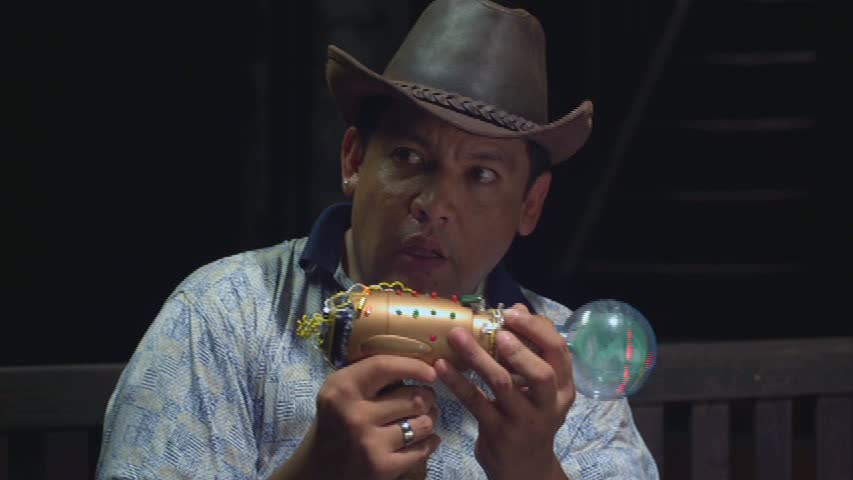 With that said, if such machine truly existed, could gays be really determined with the use of it? The film seems to do so only on a superficial level. It seems to have focused itself on gays who are effeminates and cross-dressers when, in reality, one can be as straight looking and acting as any heterosexual man and be gay. There are others, too, who may act and look effeminate, but is heterosexual. In this aspect, as what Jessica Zafra (August 24, 2011) suggests in her article, gaydars are unreliable. One should never label people as gay based on the way they act or look. Such labeling seems to become problematic not only to gay community who are boxed inside stereotypical behaviors, but to heterosexual people, as well, whose ideas about being gay are challenged.
In the Philippines, according to J. Neil Garcia’s book, Philippine Gay Culture: Binabae to Bakla, Silahis to MSM (2008), the term “bakla” alone is problematic because it doesn’t cater to all homosexuals in the country. Not every gay person is comfortable enough to use such term since it carries stigma along with it. In his article (2004), Garcia defines “bakla” as the effeminate, cross-dressing gays who are sexually attracted to straight (macho) men. On the contrary, straight men who have sexual relationships with them are not considered bakla. By such definition alone, the film’s gaydar could be in for a lot of confusion if standards are not defined clearly. (For more on Garcia’s theories, refer to his book. For a related post of mine, read this.)
Further gay stereotypes are catered throughout the film. For instance, the town mayor expresses her alarmed stance on the killings. “Limang parlor na ang nagsara (Five parlors have already closed down)," she says. "Bukod sa mababait ang mga kababayan nating third sex, they only bring beauty, joy, and laughter wherever they go. (Aside from being kind, gays bring beauty, joy, and laughter wherever they go.)” Ed, on the other hand, equates gays with beauty pageants bringing laughter to those who watch them. The film seems to agree on the stereotypical homosexual views of the heterosexuals. They have been delegated them to bringing “joy, beauty, and laughter” to the community, negating whatever human qualities they have. In the end the film has stayed in line with such arguments by making Zombadings the designers of the town’s Zombreros, making their existence conditional as if to say, "Okay lang maging bakla basta may pakinabangan (It's all right to be gay so long as they make contributions to the society)." How many times have we heard of such statements from people who seem to tolerate gays so long as they met their conditions? Has such conditions been given to heterosexuals?

The film seems to have no clear heterosexual male models. Ed (the father) is a bum who attends to their carinderia while his wife (Janice de Belen) works as a police officer/investigator. Suarez and Serg (Leandro Baldemor) are homophobes. If not seen drinking during mid-day, they kill the gays at night. Even Remington and his friends are not to be relied upon except during drinking sessions. These men (John, Daniel, and Leandro) who were the epitome of machismo in their previous movies are made to look pathetic and incompetent.


Janice de Belen (left) as a policewoman; Odette Khan (right) as the mayor
The filmmakers may argue that they only have worked behind the confines of the comedy genre. Most of the times, comedy tends to veer towards stereotypes in order to get its humor across. However, a good comedy doesn’t need to rely on the limitations of the genre. It can do away with typical characterizations and yet still be funny and sensitive to its audience at the same time. While the film is admittedly hilarious and affecting, according to Nick Tiongson, a film scholar and critic, we should be wary of this kind of films for it masks its ideologies behind the laughter, making us unaware of what ideologies it truly teaches.
Moreover, in this day where people seem to be interested in everyone’s sexuality, one shouldn’t be forced to come out just to satisfy everyone’s curiosity. For in the end, it is the outed person alone who will bear the consequences of his actions such in the case of the film where outing someone means death of/for him.
References:
Cruz, Oggs. “Zombadings: Patayin sa Shokot si Remington (2011).” Lessons from the School of Inattention. N.p. 31 08 2011. Web. 21, March 2012.
Garcia, J. Neil C. "Male Homosexuality in the Philippines: a short history." I I A S N E W S L E T T E R2004th ser. 35 (2004): 13. Print.
Garcia, J. Neil C. Philippine Gay Culture: From Binabae to Bakla, Silahis to MSM. University of the Philippines Press, 2008.
Zafra, Jessica. "It’s happened. Indie movie Zombadings beats Star Cinema. (Updated with stairway)."Jessica Rules the Universe. N.p., 03 09 2011. Web. 23 Feb. 2012.
Friday, October 19, 2012
Maling Akala Videoke (AIDS Prevention Awareness)
Video made for my MA Film 230 class under Roehl Jamon with Rhea Ramos & Paolo Apagalang
Tuesday, December 13, 2011
Nostalgia Trip
I had a pending post about nostalgia. I wrote it last night as I finished watching Top Gun, but left it for a while. I just had to write something so I could have some head start. However, incidentally today, I had encountered a Facebook post that seemed to have spoken to me. Kung noon, in trying times, you suddenly receive a text quote that seemed to be aware of what you were going through, ngayon naman ay Facebook or Twitter posts. The quote says:
Nostalgia is denial... denial of the painful present. The name for this denial is golden age thinking, the erroneous notion that a different time period is better than the one one's living in. It's a flaw in the romantic imagination of those people who find it difficult to cope.
Immediately, it felt like it was written for me. Inisip ko pa nga kung original ba ang statements na 'yun made by the poser. But it wasn't. It was a quote from a Woody Allen film called Midnight in Paris which I haven't seen (and will soon see).
I've told Gino, a friend, about it. Aware of my latest heart disaster, he suggested that I may have wanted to back to my last semester's experience. But I don't. In fact, my last semester experience is one of the reasons that had prompted me to go into this nostalgia trip that kept me away from the present time/reality.
Gino adds another quote from Mad Men which sums up what nostalgia is about:
Teddy told me that in Greek, "nostalgia" literally means "the pain from an old wound." It's a twinge in your heart far more powerful than memory alone. This device isn't a spaceship, it's a time machine. It goes backwards, and forwards... it takes us to a place where we ache to go again. It's not called the wheel, it's called the carousel. It let us travel the way a child travels - around and around, and back home again, to a place where we know are loved.
What makes nostalgia more powerful than memory is its emotive affinity.
Gino further says, "Tagos sa 'yo 'yan, Jek. Iyong-iyo talaga. Tinaub ka ng quote."
Tarantado 'tong si Gino, ah! Ang sarap kurutin sa bayag!
Once, during k'wentuhan mode with MA classmates, nasabi ko na "regressing" towards the past gives us security. Most often than not, ang natatandaan natin sa nakaraan ay 'yung mga masasayang alaala. Once healed, we tend to forget the hardships that we went through. Besides, even with such hardships, we knew that we had surpassed them so we still feel safe with them. With bruises and all, we survived it!
When I get confronted with things I couldn't handle immediately, I tend to cave in to a safer world. I'd sleep for days until I get the answer I needed or occupy my mind with activities unrelated to the situation I am facing--movies, music, blogging, etc.
 Recently, my nostalgia trip brought me back to the music of my youth where the songs were diverse and rich. May kanta para sa hilig ng bawa't isa--ballad, dance, rap, banda, novelty--at hindi lahat ng singers ay iisa ang timbre ang boses. It was a time when an acoustic song was just an alternate version of a fully orchestrated song. The lyrics were poetic at malaman ang sinasabi.
I developed a compulsion to buy original OPM CDs from the '80s and ripped them to 320 kbps. When I was done with it, I downloaded '80s music ripped to 320 kbps. Hindi lang 'yun. I had to put the exact album (or single) covers where the songs came from or else, I wouldn't be happy with it or be satisfied. It kept me busy for a while and away from the stressful situation. But I knew that once I get tired of it, I will eventually go back home--to the future. One can't keep living in the past if he wants to see the future.
Dahil pa rin kay Gino at sa tanong niya kung ano ang theme song ng Top Gun, I watched the film again. I saw it in 1986, and it made a big impression on me. It and Dead Poets Society were two films that made me appreciate Hollywood movies. Masang-masa kasi ang panlasa ko noon.
I didn't care about the action of the film. I was into the romance and the drama of it and TOM CRUISE! Nainlab ako sa mokong! Ang cute-cute naman kasi! Tapos ilalabas pa ang kanyang boy-next-door smile! Sino ba naman ang di mahuhulog sa kanya? He was my man until he went cuckoo with Katie. Bye-bye, Tom, na ang drama!
Top Gun then made an impact on me, the same way it did this 2011.
 Tom's character, Maverick, seems to be arrogant and so full of himself. But it is only on the surface. Deep inside, he wants to prove himself to the world that he is better than his father. He puts on a tough facade to hide what he truly feels inside. However, his commander is on to him. He says, "You have a confidence problem, Maverick." It is at the time when his best friend died, and he decides to quit the force because he couldn't deal with it.
I am Maverick.
I receive a somewhat good news about my Sharon Cuneta paper. It is eligible to be published in Plaridel, a UP mass communication magazine, so long that it passes the requirements after revisions have been made. The comments given are of extreme quality. May sobrang nakakagaan sa pakiramdam at may sobrang nakapanglulumo talaga.
A friend tells me to be happy more than feel bad about it. "'Wag ka ngang masukista," he says.
I agree with him. Still, I couldn't help asking myself kung bobo ba ko para di malaman ang ibang mga naging simpleng comment ng reviewer ba minsan ay spelling problem lang o pagbabaybay? (The paper is written in Filipino na akala ko ay bihasa na ko. Hindi rin pala.) Deserving nga ba talaga ang naisulat ko for publication or pangpalubag-loob lang since may potential naman daw? Alam ko namang hindi ko alam ang lahat at para rin sa ikabubuti ng research ko ang mga nasabi nila. Pero hindi ko pa rin maaalis sa sarili ko ang masaktan at pagdudahan ang sarili. I knew that I had to go through all these stages so that I'd be ready and armed to deal with it.
Maverick faces his demons. He chooses to graduate and tests his skills in battle than quit.
I choose the same. The nostalgia trip is over and done with. (For the meantime at least. Until I see the need to go on a trip again.) I sent my long-overdue response of acknowledgement to Plaridel and am hoping for a favorable response regarding the deadline. In case it is unfavorable, I only have myself to blame and the trip I made this semester.
Aside from that, last semester's heartache is over! I have moved on. The LMC fantasy has ended. Actually, matagal na akong aware sa pantasya. Pinatagal ko lang siya at pilit na nagpakalunod sa kilig na ako lamang ang gumagawa. Masarap man sa pakiramdam ang kilig, nakakaumay rin sa katagalan lalo na't mag-isa ka lang na gumagawa nito.
So ayun! Hello, world na muli!
Monday, December 12, 2011
Be Careful and Sensitive on What You Post

I am taking Media 280 this semester which is about Conflict-Sensitive Journalism. It teaches us to be sensitive and careful about the things we write and their implications. One's writing could be read differently if one isn't too careful.
Look at this post about AIDS: Is HIV Common in Manila?
The post is talking about AIDS in Manila, yet suddenly seques to Sydney. One reader couldn't help asked if he was talking about the AIDS situation in Manila or in Sydney. Of course, I understand that it isn't a professional and researched write-up. The blogger was merely expressing his thoughts. But what has bothered me more is the use of RJ Rosales's picture for his post. What is he trying to imply with such use of his picture?
RJ recently passed away due to unspecified reasons. With that, people normally speculated that could've died of (complications of) AIDS. But they were just speculations at tsismi-tsismisan ng ating mga kapatid na nagkakape sa Starbucks. Nothing is confirmed. However, in case RJ did die of AIDS, so what? We shouldn't be quick to judge the person.
So, is the post trying to imply that RJ has died of AIDS given that he was in Sydney at the time of his demise?
As what the late Ate Luds used to say, "Careful, careful!"
Photo source: Be careful where you eat a corndog
Tuesday, May 17, 2011
Reposting: Zombie
Originally posted on April 12, 2010.
It took a while before I finally decided to upload the final film in Facebook. I've had a few friends asking me to show them the film, but I just told them that I'd upload it soon. My hesitation stems from how personal this work is--not just because I'd literally shed tears in doing this project, but because it is a personal story. I was protective of it like any Hollywood movie stars protective of their newly-born babies from the paparazzi or the way Pia Magalona is to Francis M's last recordings.
Sino ba naman ang gugustuhing pulaan ang kanilang trabaho ng kung sinu-sino lang? No matter how bad it turned out to be, baby ko pa rin siya. I wouldn't just let anyone say anything bad against it. (Pero kung pangit man siya sa standards ko pa lang, hindi na ko magkakalakas pa ng loob na ipakita siya sa iba.)
Ayoko rin namang makatanggap ng sobra-sobrang papuri from people who feel obliged to do so just because we're related or we're friends. Hindi rin naman ako mapapanatag sa ganu'n. I want some objectivity and not biases.
If I sound too critical of what others might think about my film, it is because I am critical about it myself. I have wanted to do a film of my own, and I didn't want to screw it up kahit pa sabihing I have a huge margin of error since it's my first time.
Fortunately, when I showed the rough draft to my professor, nagustuhan na niya. When it was finally shown at mag.net Katipunan on March 25, 2010 and was judged by Auraeus Solito (of Ang Pagdadalaga ni Maximo Oliveros), he liked it, saying that it could already be sent to gay and lesbian film festivals abroad. My professor added na mataas daw ang grades na nakuha ko.
Nakahinga na ako ng maluwag nang marinig ko 'yun. Sobrang pinaghirapan ko ito, and I'm very much proud of it!
Yet, at the back of my mind was the question, what now? What is the next step for me?
I don't know actually. But I'm hoping that this could be the start of something good!
Anyway, before you watch the film, here's a few guidelines Sabi nila, let the audience interpret the film for themselves. However, gusto ko pa rin ibigay ang mga bagay na ito dahil pelikula ko ito!
WARNING: Some scenes and theme may offend the sensibilities of some viewers. Watch it with caution (or not at all).
Synopsis:
Zombies walk amongst us. Tonight a zombie stares at his current flame as he reminisces happier days with his dead lover.
He dresses up in white with black linings in front of a broken mirror. After which he leaves the house and joins the land the living as other zombies often do.
* This is purely a visual medium, so everything you see on screen has a purpose.
* Lahat ng prop ay may sinasabi tungkol sa kuwento ng pelikula.
* Ang mga piniling kulay ay may dahilan. Maging ang texture ng kurtina at bed sheet ay may sinasabi. Maging ang suot ng karakter ay may kuwento.
* Ang basag na salamin ay hindi isang basag na salamin lamang. May kinalaman ito sa taong nakatingin dito.
* May palabas sa portable DVD player. Hindi nga lamang siya nakita masyado. But it is a BURIAL SCENE from the movie Nakapagapos na Puso.
* The scene with the DVDs, books, and cassette tape say a lot with what had transpired between the past and the present. Read the texts.
* Take note of the album ENDLESS LOVE by Diana Ross and Lionel Richie.
* May konting boo-boo sa bandang huli. Matapos pagtawanan, 'wag na pansinin. Wala na kong magagawa sa katangahan kong iyon. 'Yung nilalaman na lang ng eksena ang bigyang-pansin. Hehehe.
Ito rin ang isa sa naging puna ni Auraeus when he saw it. Other than that, OK sa kanya ang buong pelikula.
* There could be quite a few interpretations to the film's message. If you have your own, feel free to post a comment. I'd love to hear them.
* I am truly a Sharonian! Napakaraming Sharon references sa movie na ito. Hindi ko kinakahiya 'yon! :)
So, enjoy!




Zombie: Behind the Scenes
 This was written on March 26, 2010. I posted it online, but decided to keep it hidden later on. Now it's back online! I don't see the need to not post it. I made some notes, though, so I wouldn't forget some details.
"Jheck David is finally done with editing and sound design! Nakakaiyak..." was my status last night. Ivy asked why--'yung story raw ba o 'yung pag-e-edit.
Lahat-lahat ay nakakaiyak. I really didn't have an actual moment of break down during the production of my short film, Zombie, but I was almost in the brink of tears. I came to the point of asking whether tama ba ang path na pinu-pursue ko or I just need to stick with what I do best. (Pero ano nga ba ang bagay na I do best?) Was I just fooling myself into thinking na may mararating ako sa film or was I just doubting myself?
Story-wise, makailang ulit din ako nagpalit. I thought that I already have a story in mind the first time until ma-realized ko na hindi naman gaanong cooperative 'yung gusto kong maging part ng film. Ayoko namang mag-demand ng husto sa time niya since "tulong" lang naman talaga 'yung gagawin niya sa 'kin. (It was a story inspired by a colleague from Star Cinema. There was an emotional dance involved in it.)
I changed my storyline and felt that I was already set on my concept. Only that feeling ko na may kulang pa. Na kailangan ng tweaking. Hindi ko lang malaman kung sa'ng parte itu-tweak.
I had my zombie world set-up na, pero di pa maayos. Medyo sabog pa. Instead of too many zombie stories, I focused myself on one--on my lead. It worked for me. Maski sa production design (used as plot) ay nag-work din. Solb na ko!
Location. Hindi pumayag 'yung unang hinihingan ko ng pabor. Hindi niya man kinunsider at least for a while 'yung idea on using his place. Basta ayaw niya. I was quite upset about it, pero natanggap ko rin. Sabagay di naman ako ganu'ng ka-close sa kanya para isiping pagbibigyan niya ko. (He is a dancer who happens to know the guy who was the inspiration of the first SL I had which I mentioned earlier. That latter guy is a dancer, too.)
Anyway, I asked my best friend her place. She immediately agreed. Ewan ko ba kung bakit nagtanong muna ako sa iba kaysa sa kanya. Ayoko lang kasing i-hassle siya with the shoot o maobliga siyang pumayag dahil best friends kami. Pero bakit ka nga naman titingin sa malayo kung mayro'n namang mga taong nasa malapit at handang tumulong anytime?
The day before the shoot, wala akong makuhang actors! Ilang tao rin ang pinagtanungan ko at hiningan ng contacts, pero wala. With the "demands" of the story, mahirap makakuha ng artistang papayag with a minimal pay. Hindi ko naman pwede pang taasan ang talent fee dahil kapos na kapos din ako. Bukod pa ru'n, four minutes lang ang film. Hindi required na super galing umarte. Basta willing to show skin and do gay scenes. Muntik na nga akong mag-resort sa mga CBs, pero maging sila ay maaarte rin.
Nagtanong ako sa taong iniiwasan ko kung may kilala siyang pwedeng gumanap para sa film ko. (Hindi naman niya alam na iniiwasan ko siya actually.) Kasubuan na. Nagbakasakali ako. Ayun! Nakahanap siya. Ang laking pasasalamat ko sa kanya. If not for him, maaantala ako ng husto, and I was already pressed for time. (Iniwasan ko siya dahil may writing job ako sa kanya na hindi ko tinapos. As it turned out, hindi na rin pala siya nagtatrabaho sa producer namin na isa ring artista at direktor na may asawang aktres/host. May anak silang kambal.)
Shoot went well sa tulong din ng mga kaibigang tunay. Inabot man kami ng dilim sa labas ng bahay, keri na. Maganda rin naman lumabas sa camera 'yung night effect. Ang nagpatagal lang kasi sa 'min ay ang zombie make-up. Hindi ko in-expect na ganu'n siya kagatal ilagay. It took almost 2 hours to finish. Isang tao lang ito! Na-imagine ko na if I had a bunch of zombies, it will take us the whole day to put make-ups on them! Or, I need more than 2 make-up artists!
Editing. Sobrang kinatakutan ko siya. Hindi ako marunong. I only know how to use Windows Media Maker. Ang gusto ko sana ay fancier editing software. I thought of hiring an editor. Gusto kong maganda ang kalabasan ng film dahil kulang ang tiwala ko sa mga kuha ko. Editing ang sagot para magkaru'n ito ng style o mapaayos ang kuwento.
Pero panibagong gastos ang editor! Wala na kong budget for it. Claudine suggested that I should try editing the film myself. Iga-guide niya ako sa Adobe Premiere. I tried pero pakiramdam ko na I don't have much time learning Adobe. Kakainin nito masyado ang oras ko. I opted to use WMM kahit hindi masyadong stylized. Na-enjoy ko naman siya. Maganda ang kinalabasan. When I showed it to my professor, nagustuhan niya ang pagkaka-edit ko at ang kinalabasan ng film.
Scoring. Isa ito sa kinatakutan ko pa. Nu'ng una pinroblema ko ang music. Saan ako kukuha ng original music? Isa sa nahingan ko ng kanta ay isa sa mga naging estudyante ko sa Northfield. Grade 1 lang sila nu'n when I handled them. 3rd year high school na sila ngayon. Fortunately, di naman niya ko binigo. Binigyan niya ako ng 3 original compositions para sa film. Only that when my prof learned about it, sabi niya na di pwede ang music! It has to be sound design.
Shet!
Nakakaloka talaga. Lagi na lang may bump on the road whenever I thought that things are starting to go smoothly. Pa'no ako magde-design ng sound? I can't use much of my live sound since may mga instructions ako while we were filming. Wala rin naman akong editing sound software that could filter sound well.
Nag-search ako ng sound effects sa net at luckily, may mga nahanap naman ako na bagay sa film. Pero hayup! Hindi mailapat using WMM! Ni-reformat ko na nga ang PC ko para maiwasan na 'yung freezing na ginagawa ng WMM, pero sa sound naman siya nag-alburuto.
I searched for codecs that WMM might need to put sound pero wa epek. Dati naman ay tumatanggap siya ng sound. Hindi ko alam ang problema niya this time.
Lo and behold! A few days ago, bigla siyang gumana! Parang sinubukan lang ang pasensya ko talaga.
When I was done sound designing, halos maiyak ako sa tuwa! Hindi ko akalaing magagawa ko ng mag-isa ang post-production using WMM. Kinabahan kasi ako since 'yung mga classmates ko, may alam na sa editing. Magaganda 'yung previous works nila. Ako, super bagito! Pinaka-thunder sa kanila, pero pinaka-bagets re film technicalities.
Bigla kong nasabi sa sarili ko, "Shet! Ang ganda!"
Yesterday a few hours before the screening, nagka-problem ako with the volume. Using .wmv, malakas ang sound niya. I had to tone it down several times dahil ayokong lunurin sa sound ang film. Kailangang maramdaman ang lungkot throughout the entire film.
After feeling that sound volume is OK na, I made an .avi copy that I'd use to convert it to DVD.
Shet! Ang hina ng sound.
I made several tweaking sa sound only to learned that once I convert it to DVD, super lakas ang lumabas! So I had to go back to my original files and tweak the sound and made an .avi copy again to turn it into DVD.
Sa sobrang tagal, inabot na ko ng 4PM! 6PM ang screening ng class namin sa mag:net Katipunan. Nakaalis ako ng bahay ng 4:45PM. Nakakuha ako ng taxi ng almost 5:30PM.
Sa sobrang kaba ko na late kami darating sa place, di ko na masyado nakausap si Acy sa taxi. Pero ayun, past 6 kami dumating at di pa nag-i-start. May plano talaga si God, sabi ko. Hindi Niya ko pinasakay ng taxi kaagad kasi alam Niyang di naman magsisimula on time talaga. Tamang oras lang ang pagdating ko.
Happy na nga ako at andu'n si Acy at si Gino. For a while inakalang wala akong magiging bisita that night. Hindi pwede ang ibang mga kaibigan ko that night. Salamat na lang sa dalawa at hindi ako nag-isa.
(It was truly a memorable event because Auraeus Solito, who was one of the critiques that night, commended the film. Buo raw ang kuwento at punong-puno ng emosyon. Pwede na raw isali sa mga gay film competitions abroad.)
Friday, March 18, 2011
Monday, March 14, 2011
"Bata, Bata... Paano Ka Gagawin?" Online Premiere
 Bata, Bata... Paano Ka Gagawin? premieres online on March 16!
Starring:
Joey Paras
Geng de los Reyes-Delgado
and
Ms. Gigi Locsin
Introducing:
Aries Hermoso


Written & Directed by:
Producer:
Myrna C. Josue
Assistant Director/Production Design:
Acy Ramos
Director of Photography/Light Designer:
Don Santella
Make-up Design/Gofer:
Rhea Zaratan
Location Manager:
TJ Parino
Stills Photographer:
Gilbert Sococ
Editor/Sound Design:
Adam Joseph
Talent Coordinator:
Danni Ugali
Sineasta Productions
2011
Thursday, September 02, 2010

Subscribe to:
Posts (Atom)